How to Read a K2 Product Label: Warning Signs, Ingredients, and Safer Decisions
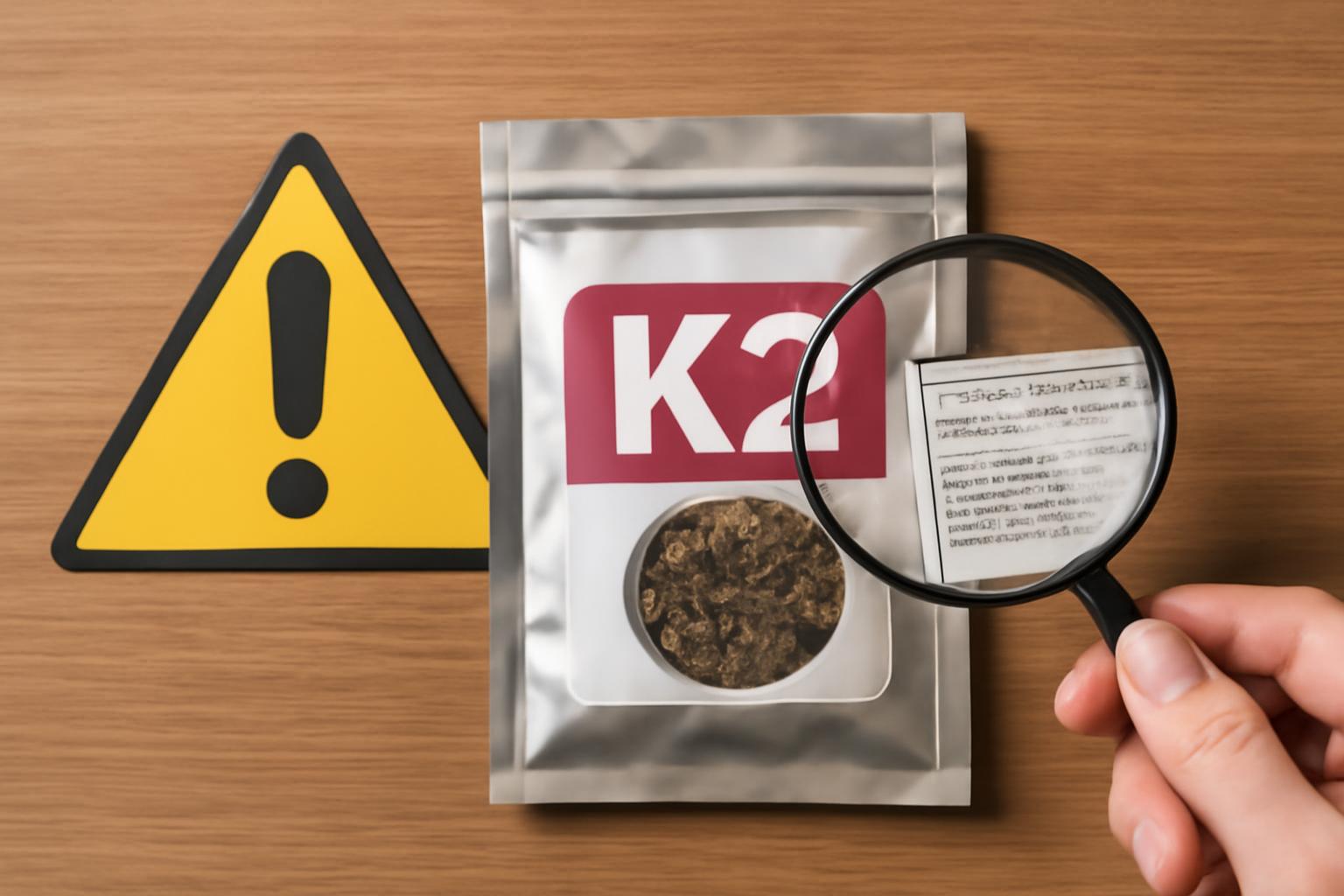
K2 product label warning signs: Products sold as K2, Spice, synthetic cannabis, fake weed, or herbal incense are not equivalent to regulated cannabis. Their contents, strength, and legal status can vary widely. Some products contain undisclosed synthetic cannabinoids or other research chemicals and may cause severe, unpredictable effects. The safest choice is not to use an unknown product. If someone is having a medical emergency, call 911 or contact Poison Control at 1-800-222-1222 in the United States.
There is no single reliable formula for K2 or Spice. These names are often used for mixtures of plant material and laboratory-made compounds that act on cannabinoid receptors. Packaging may describe a product as incense, potpourri, or a legal high, but those descriptions do not establish what is inside or make a product safe for human consumption.
Learning to identify K2 product label warning signs can help consumers, caregivers, educators, and retail staff recognize risk before a product is handled or used. This guide focuses on label literacy, not instructions for consuming, preparing, spraying, or modifying synthetic cannabinoids.
Why K2 labels can be difficult to interpret
Manufacturers of synthetic cannabinoid products may change formulas quickly in response to regulation, supply changes, or attempts to avoid detection. The same brand name can therefore refer to different chemicals at different times. A familiar package, colorful design, or positive online review cannot confirm a product’s identity.
Many products also use broad terms such as “herbal blend,” “aromatic potpourri,” “research chemical,” or “not for human consumption.” These terms may describe the marketing category rather than the actual chemical contents. A disclaimer is not a certificate of laboratory testing, purity, or safety.
For background, readers can review the Insense High homepage and compare how product categories such as herbal incense, liquid products, and paper products are presented. Category language should always be treated separately from verified chemical information.
Seven K2 product label warning signs
1. The ingredient list is missing or unusually vague
A label that lists only “herbs,” “botanicals,” or “proprietary blend” does not identify the active ingredients. Plant names alone also do not prove that the product is free from synthetic cannabinoids. If the package provides no specific chemical identity, concentration, batch number, or testing information, the contents should be considered unknown.
Labels that say “100% natural” deserve particular caution. Synthetic cannabinoid products may be applied to plant material, and a natural-looking carrier does not make the active compound natural. Marketing language should never override the absence of verifiable testing.
2. The package uses claims such as “safe,” “legal everywhere,” or “no side effects”
Absolute safety and legality claims are major warning signs. K2 and related products may be controlled under federal law, state law, or analogue laws, and rules can change. A product sold online or displayed in a store is not necessarily legal in the buyer’s location.
Similarly, “legal high” is a marketing phrase, not a medical or regulatory classification. No label can guarantee that a product will not cause anxiety, psychosis, seizures, rapid heart rate, vomiting, kidney injury, or other serious effects.
3. The product promises effects that are unusually intense or immediate
Claims such as “stronger than cannabis,” “instant euphoria,” “extreme potency,” or “all-day effects” can signal an especially risky product. Potency may vary from one portion of a package to another, particularly when a chemical has been unevenly distributed across plant material or paper.
Descriptions that encourage users to take more because the initial effect is delayed are also unsafe. Delayed effects can lead to accidental overexposure, while the duration and intensity of synthetic cannabinoid effects may be difficult to predict.
4. There is no batch number, date, manufacturer, or contact information
Responsible labeling should make it possible to identify the manufacturer, production batch, and a way to report a problem. A package that has only a brand name, logo, or social media handle provides little accountability.
Missing information becomes especially concerning when the seller refuses to provide a certificate of analysis from an independent laboratory. Even when a certificate is offered, check whether it matches the exact product, batch, and date. A generic document or an image without traceable details does not establish that the item was tested.
5. The design imitates food, candy, medicine, or a familiar cannabis brand
Bright packaging, cartoon imagery, candy-like names, and familiar symbols can make a dangerous product appear less serious. This is a significant concern for children, teenagers, and anyone who may mistake the package for an ordinary consumer product.
Keep unknown powders, liquids, papers, and herbal blends away from children and pets. Do not transfer them into food containers, drink bottles, unlabeled jars, or other packaging that could cause accidental ingestion.
6. The label tells users how to alter or intensify the product
Instructions involving spraying, soaking, mixing, heating, concentrating, or combining a product with another substance are a serious red flag. Such actions can create uneven dosing, increase exposure to solvents or contaminants, and make an already unpredictable substance more hazardous.
Do not attempt to manufacture or modify K2 at home. Online instructions may omit critical information about chemical compatibility, ventilation, fire risk, contamination, and dose variation. Product pages and discussions that present preparation as simple or routine should not be treated as safety guidance.
7. The label changes from one purchase to another
Frequent changes in logos, names, package sizes, claimed ingredients, or effect descriptions may indicate formula changes or attempts to avoid scrutiny. A product that was previously described as one type of blend may not contain the same compound later.
For this reason, a prior personal experience does not predict the safety of a later package. The brand name, color, or appearance is not a reliable quality-control system.
What common label terms really mean
“Herbal incense” and “potpourri”
These terms often describe how a product is marketed, not how it is used. They do not confirm that the product contains only herbs or that it is intended for safe inhalation. Burning or inhaling unknown material can expose a person to synthetic cannabinoids, combustion products, residual solvents, mold, or other contaminants.
“Research chemical”
A research chemical is not automatically a pharmaceutical-grade or laboratory-certified substance. The term may refer to a compound sold for analytical or scientific purposes, but it can also be used loosely in online marketing. A label should not be interpreted as proof of purity, correct identity, or suitability for people.
“Not for human consumption”
This disclaimer does not remove the health risk. It may be used to avoid regulatory scrutiny while a product is marketed in a way that suggests intoxicating use. If packaging and advertising imply that a product is intended to produce a high, the disclaimer should not be treated as a safety measure.
“Lab tested”
Look for specific information rather than relying on the phrase alone. Useful documentation should identify the laboratory, test date, batch number, analytical method, and compounds detected or not detected. A test report for a different product or an old batch does not verify the package in front of you.
Why ingredient names may not tell the whole story
Synthetic cannabinoids are a broad and changing group of compounds. Some are chemically unrelated to the compounds most people associate with cannabis, despite producing activity at similar receptors. New analogues may appear under unfamiliar names, abbreviations, or inconsistent spelling.
Labels can also omit inactive ingredients, dyes, solvents, heavy metals, pesticides, or microbial contamination. A listed compound may be present at a different concentration than stated, while an unlisted compound may be present without disclosure. This is why packaging cannot replace independent testing or medical advice.
Readers researching chemical terminology may find the site’s post archive sitemap useful for locating related educational discussions. However, no blog post, product description, or customer review can confirm the contents of an unknown K2 product.
How to make a safer decision around an unknown product
- Do not rely on the name. K2, Spice, fake weed, and brand names can be reused for different formulas.
- Do not taste, inhale, or handle loose material unnecessarily. Avoid contact with the eyes, mouth, and broken skin.
- Do not mix it with alcohol, cannabis, prescription medicine, stimulants, opioids, or other drugs. Interactions can be unpredictable.
- Keep the original packaging. If an exposure occurs, medical professionals may need the label, batch information, or remaining product.
- Wash hands after accidental contact. Avoid touching the face or eating until hands have been cleaned.
- Dispose of suspicious material carefully. Do not pour unknown liquids down drains or leave products where children, pets, or other people can access them.
- Check local rules. Possession, sale, and shipping restrictions can differ by state and municipality.
For broader navigation, the site’s category sitemap shows how topics and product categories are organized. Category placement is not a statement that a product is approved, safe, or legal in every state.
What to do if someone develops symptoms
Possible signs of a serious reaction include confusion, extreme agitation, hallucinations, loss of consciousness, severe anxiety, chest pain, trouble breathing, repeated vomiting, seizures, or dangerously fast or irregular heartbeat. Synthetic cannabinoid reactions can change quickly.
Call 911 for severe symptoms, unconsciousness, seizures, breathing problems, chest pain, or immediate danger. Do not leave the person alone, restrain them, or make them vomit. Move hazardous objects away, place an unconscious but breathing person on their side if safe to do so, and tell emergency responders what may have been taken. In the United States, Poison Control can provide guidance at 1-800-222-1222.
Frequently asked questions
Can a “legal” K2 label prove that the product is safe?
No. Legal status and health risk are separate questions. A product may be mislabeled, restricted under another law, or dangerous even where enforcement is unclear.
Is herbal incense the same as cannabis?
No. Herbal incense may contain synthetic cannabinoids or other chemicals and is not a predictable substitute for regulated cannabis. The word “herbal” does not establish the ingredients.
Can a product review verify what is in K2?
No. Reviews describe individual experiences and may refer to a different batch. They cannot replace batch-specific analytical testing.
Does a “not for human consumption” warning make use acceptable?
No. It is a disclaimer, not a safety certification. If a product is marketed for intoxicating effects, treat it as an unknown and potentially hazardous chemical mixture.
Bottom line
The most important K2 product label warning signs are vague ingredients, absolute safety claims, missing batch information, exaggerated potency promises, food-like packaging, modification instructions, and inconsistent labeling. When a package cannot clearly identify what it contains and provide verifiable testing, assume the contents are unknown.
Understanding labels can support better prevention and faster emergency response, but it cannot make synthetic cannabinoids predictable. Avoiding unknown K2 and Spice products remains the most reliable way to reduce the risk of poisoning, accidental exposure, and serious health effects.