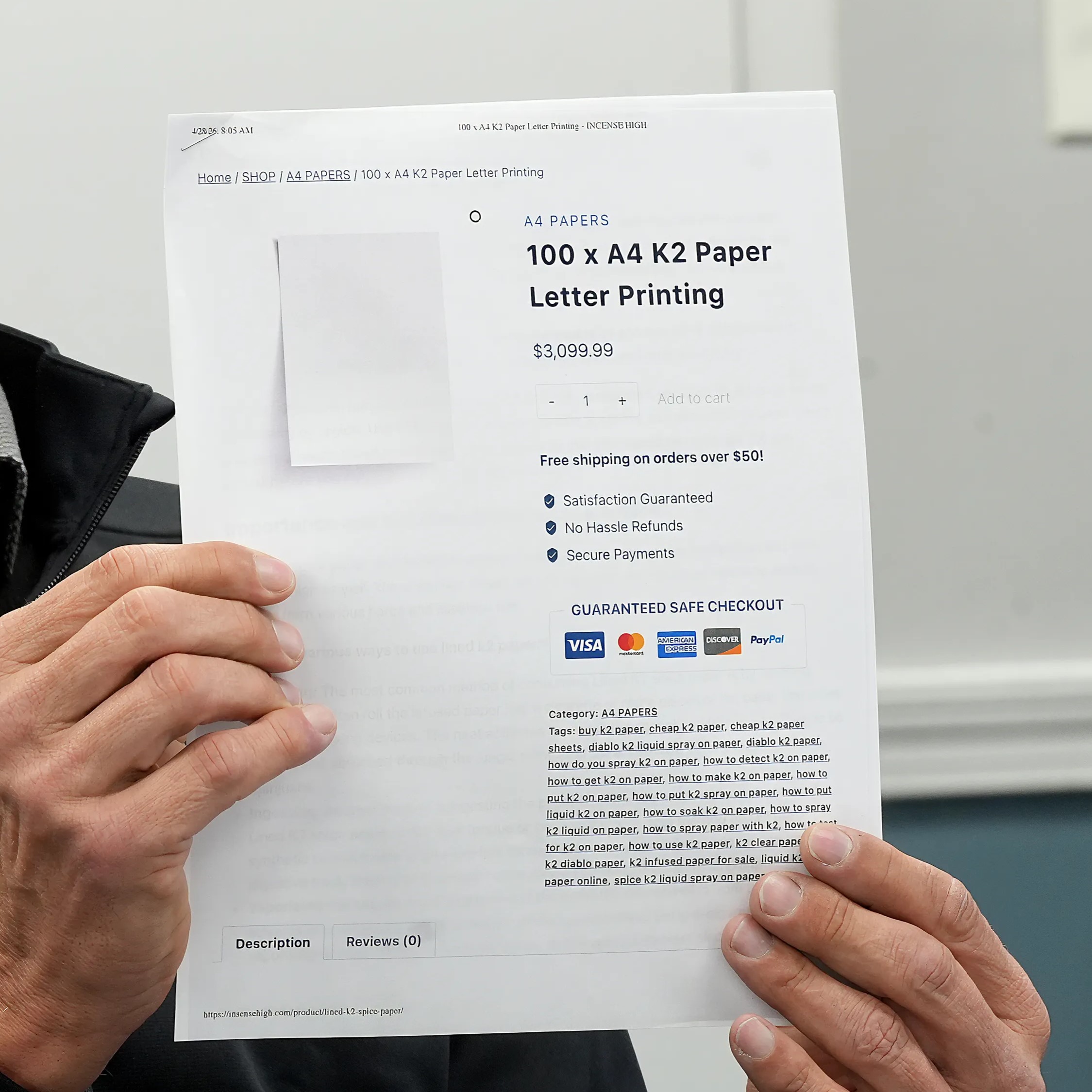
K2 Paper Delivery Idaho: State Regulations, Product Overview, and Public Health Guide
This comprehensive guide examines the regulatory status, physical characteristics, public health advisories, and consumer transparency standards surrounding K2 paper delivery in Idaho. Designed for adult researchers, policymakers, and consumers seeking factual information, this article provides an objective overview of how synthetic cannabinoid products are defined, tested, regulated, and restricted under both state and federal law.
What Is K2 Paper?
K2 paper—sometimes referred to in retail and online marketplaces as synthetic cannabinoid paper, infused paper, or liquid K2 sheets—refers to absorbent paper substrates that have been sprayed with or soaked in liquefied synthetic cannabinoid compounds.
Production and Physical Format
Unlike traditional herbal incense blends (which utilize dried botanical substrates like damiana or marshmallow leaf), K2 paper uses paper as a carrier medium. The production process generally involves:
- Chemical Dissolution: Synthetic cannabinoid powders (lab-created molecules designed to interact with the body’s cannabinoid receptors) are dissolved in volatile organic solvents such as acetone or ethanol.
- Substrate Application: The liquid mixture is applied to sheets of paper (ranging from standard printer paper and cardstock to specialized absorbent sheets) via spraying, dipping, or soaking.
- Drying and Distribution: Once the solvent evaporates, the active synthetic compounds remain embedded within the paper fibers. The sheets are then distributed whole, perforated, or cut into smaller units.
Connection to Synthetic Cannabinoids
Synthetic cannabinoids are a diverse class of human-made chemical compounds that act as full agonists at cannabinoid $CB_1$ and $CB_2$ receptors in the central nervous system and immune system. While natural THC found in cannabis acts as a partial agonist at $CB_1$ receptors, many synthetic compounds bind with far greater affinity and efficacy. This fundamental pharmacological difference accounts for the significantly higher potency and severe toxicological risks associated with synthetic compounds compared to organic cannabis.
Idaho State Laws and Federal Regulations
Understanding the legal landscape surrounding K2 paper delivery in Idaho requires examining both federal controlled substance schedules and Idaho’s state-level drug legislation.
Idaho State Statutes
Idaho maintains some of the strictest controlled substance statutes in the United States. Under the Idaho Uniform Controlled Substances Act (Idaho Code Title 37, Chapter 27):
- Broad Category Bans: Idaho law explicitly schedules entire chemical families of synthetic cannabinoids, including naphthoylindoles, phenylacetylindoles, benzoylindoles, cyclohexylphenols, and tetramethylcyclopropanoylindoles.
- Analogue Provisions: Idaho statute includes comprehensive controlled substance analogue clauses. Under these provisions, any chemical substance that is substantially similar in chemical structure or biological effect to a controlled substance is automatically classified as a Schedule I controlled substance.
- Possession and Distribution Penalties: Purchasing, possessing, delivering, manufacturing, or importing synthetic cannabinoid products—including K2 paper—within or into the state of Idaho constitutes a severe criminal offense, often prosecuted as a felony depending on the quantity involved.
Federal Regulatory Framework
At the national level, multiple federal agencies regulate and enforce laws regarding synthetic compounds:
- U.S. Drug Enforcement Administration (DEA): Through the Synthetic Drug Abuse Prevention Act (SDAPA) and emergency scheduling authorities under the Controlled Substances Act (CSA), the DEA classifies major synthetic cannabinoid families as Schedule I controlled substances.
- U.S. Food and Drug Administration (FDA): The FDA has not approved synthetic cannabinoids for human consumption or over-the-counter retail sale. The agency regularly issues warning letters and public advisories regarding unapproved synthetic compounds marketed online.
- Interstate Commerce and Mail Regulations: Shipping controlled substances or illegal synthetic analogues across state lines via the U.S. Postal Service (USPS) or private commercial carriers violates federal postal and drug trafficking laws.
Health Risks and Public Health Safety
Public health organizations, including the Centers for Disease Control and Prevention (CDC) and the National Institute on Drug Abuse (NIDA), have documented significant health hazards linked to synthetic cannabinoid exposure.
Unpredictable Potency and “Hot Spots”
A primary risk factor associated with K2 paper and related products is manufacturing inconsistency. Because these items are produced in clandestine or unregulated laboratory settings, chemical distribution across a single sheet of paper is rarely uniform.
- Concentration Variations: One section of an infused sheet may contain a minimal concentration of active chemical, while an adjacent section may contain a lethal “hot spot” where concentrated chemical accumulated during the drying process.
- Chemical Blends: Manufacturers frequently mix multiple distinct synthetic compounds, residual solvents, or unlisted adulterants in a single batch, making biological effects completely unpredictable.
Acute Medical Effects
Physical and psychological reactions to synthetic cannabinoids can be sudden and severe. Reported adverse health effects include:
| Biological System | Observed Adverse Symptoms |
| Cardiovascular | Severe tachycardia (elevated heart rate), dangerous spikes in blood pressure, chest pain, cardiac arrhythmias, and acute myocardial infarction. |
| Neurological | Confusion, extreme agitation, tremors, muscle spasms, loss of consciousness, severe seizures, and potential stroke. |
| Psychiatric | Intense paranoia, hallucinations, acute psychosis, severe panic attacks, and violent behavioral changes. |
| Renal & Metabolic | Acute kidney injury (AKI), severe vomiting (hyperemesis), hyperthermia, and metabolic acidosis. |
Emergency Medical Response
If accidental exposure or ingestion of an unverified synthetic substance results in adverse health symptoms:
- Call Emergency Services: Contact 911 or local emergency medical services immediately.
- Contact Poison Control: Call the American Association of Poison Control Centers at 1-800-222-1222 for real-time guidance from medical toxicologists.
- Provide Context: Inform medical personnel of any physical packaging, paper substrate, or labeling available to assist clinical treatment.
Consumer Verification and Label Transparency
In markets where commercial retail items, botanical blends, or industrial substrates are distributed, product transparency is essential for safety, quality assurance, and legal compliance.
The Role of Certificates of Analysis (COA)
A Certificate of Analysis (COA) is an official document issued by an accredited, independent third-party testing laboratory. A comprehensive COA for any botanical or paper-based retail product should verify:
- Cannabinoid/Compound Profile: Detailed breakdown identifying specific active molecules and quantifying their precise percentage concentrations.
- Residual Solvent Analysis: Testing to ensure volatile processing solvents (such as acetone, methanol, or hexane) have been completely purged from the final product.
- Heavy Metals Screening: Verification that the substrate is free from harmful heavy metal contamination (such as lead, arsenic, cadmium, and mercury).
- Pesticide & Microbe Testing: Confirmation of the absence of synthetic pesticides, mold, mildew, and harmful bacteria.
Red Flags in Product Labeling
When reviewing commercial products or online listings, consumers and researchers should exercise caution if any of the following warning signs are present:
- Lack of traceable manufacturer contact information or physical business address.
- Absence of batch-specific lot numbers linked to verifiable laboratory reports.
- Vague ingredient lists using broad terms like “proprietary aromatic blend” without specifying exact carrier materials or ingredients.
- Unrealistic marketing claims suggesting universal legality, total safety, or therapeutic properties without FDA backing.
Why Product Transparency Matters
The distinction between commercial branding and verified laboratory data is critical when evaluating consumer products. Commercial names, decorative packaging artwork, and catchy product titles are created solely for marketing identification; they provide zero factual indication of a product’s true chemical composition, safety profile, or legal status.
Transparent practices—such as clear ingredient disclosure, accessible batch testing, explicit safety warnings, and strict compliance with local statutes—help protect public health, prevent accidental poisonings, and ensure that buyers make informed decisions based on factual documentation rather than unverified commercial claims.
Frequently Asked Questions About K2 Paper Delivery in Idaho
1. What is K2 paper?
K2 paper is a term used to describe paper sheets or substrates that have been sprayed or soaked with synthetic cannabinoid compounds dissolved in organic solvents.
2. Is K2 paper legal in the state of Idaho?
No. Idaho state law strictly prohibits synthetic cannabinoids and their chemical analogues under Idaho Code Title 37, Chapter 27. Possessing, selling, delivering, or shipping synthetic cannabinoid products into Idaho is illegal under both state and federal law.
3. Can synthetic cannabinoids be detected on drug tests?
Yes. While standard workplace 5-panel drug screens typically target natural cannabis metabolites ($THC-COOH$), specialized laboratory drug panels (such as LC-MS/MS urine and blood assays) are designed to detect synthetic cannabinoid compounds and their specific metabolites.
4. What are the main health risks of K2 paper?
Health risks include severe cardiovascular distress (rapid heart rate, high blood pressure), acute kidney injury, seizures, extreme paranoia, hallucinations, psychosis, and potential overdose due to inconsistent chemical concentrations (“hot spots”).
5. What should I do if someone experiences an adverse reaction to a synthetic substance?
Seek emergency medical assistance immediately by calling 911 or contacting Poison Control at 1-800-222-1222. Do not wait for symptoms to dissipate on their own.
External & Internal Resources
Authoritative Public Health Resources
- U.S. Food and Drug Administration (FDA): Federal regulatory guidance on unapproved synthetic substances and consumer safety advisories.
- Centers for Disease Control and Prevention (CDC): Public health facts, toxicity reports, and emergency guidance regarding synthetic cannabinoids.
- U.S. Drug Enforcement Administration (DEA): Federal controlled substance schedules, drug facts, and legal status updates.
- Idaho State Legislature: Official access to Idaho Code and state controlled substance statutes.
Website Navigation
- Explore our main catalog and product documentation at Incense High.
- Review detailed educational guides and product categories on our herbal incense products page.
-

-

-

-

-

-

-

-

-

-

-

-

-

-

-

-

-

-

-
-
-

-

-

-

-

-

-

-
-

-

-

-

-

-

-

-

-

-

-

-

-

-

-

-

-

-
-
-
-
-
-
-
-

-

-

-

-

-

-

-

-

-

-

-

-

-

-

-

-

-

-

-

-

-

-

-

-

-

-

-

-
-

-

-
-

-
-

-

-
-

-

-

-

-

-
-

1X Legal High K2 Paper
Price range: $125.00 through $175.00Select options This product has multiple variants. The options may be chosen on the product page -

-

-

-